


The Complete Guide to AP Invoice Automation: What It Is, How It Works, and What to Look for in 2026

Category
Accounts Payable Automation
Published Date
April 27, 2026
Reading Time
5 Min Read
The Complete Guide to AP Invoice Automation: What It Is, How It Works, and What to Look for in 2026 — Velocious AP Automation
Accounts payable invoice automation uses advanced software to digitize and process vendor invoices without manual data entry. Real-world research demonstrates its transformational value: in our recent AP Automation Survey of 34 large enterprises across multiple sectors, over half process more than 100,000 invoices annually, with 30% handling 300,000+ invoices—often with lean AP teams thanks to automation.
Survey findings further reveal that 50% of respondents achieve OCR accuracy above 90%, and 25% of companies auto-post over 70% of their invoices—key indicators of automation maturity. These organizations also report faster approval cycles and reduced manual intervention, directly accelerating the financial supply chain while reducing risk and human error.
Velocious AP Automation leverages this next-generation technology, aligning your enterprise with leading industry benchmarks and setting the stage for continuous performance improvement.
For many organizations, managing the influx of vendor invoices remains a complex, paper-heavy burden. Forward-thinking companies view their internal operational processes as a direct source of competitive advantage, and modernizing accounts payable is a vital step in that digital transformation.
This guide breaks down exactly what you need to know about accounts payable invoice automation. We will explore its definition, outline the step-by-step process of how it functions, compare deployment models, and provide actionable criteria for selecting the best solution for your business in 2026.
What is AP invoice automation?
Accounts payable invoice automation is the technology-driven process of removing manual intervention from your invoice lifecycle. Instead of printing emails, typing data into an enterprise resource planning (ERP) system, or chasing down managers for physical signatures, software handles the heavy lifting.
By leveraging artificial intelligence and machine learning, modern systems read invoices much like a human would. They identify the vendor, amount, line items, and terms. This technology seamlessly transforms unstructured data into structured, actionable information. As a result, finance teams shift their focus from tedious data entry to strategic financial analysis and relationship management.
How does AP Automation work?
Implementing AP workflow automation fundamentally changes the daily routine of your finance department. While legacy systems rely on human intervention at every stage, automated platforms operate smoothly in the background.
Here is the step-by-step process of how an automated AP workflow operates:
- Centralized Capture: The system ingests invoices from multiple sources—including email, EDI, and supplier portals—digitizing any remaining paper documents via Optical Character Recognition (OCR).
- Intelligent Data Extraction: Artificial intelligence extracts key header and line-item data. It identifies the supplier, invoice number, due date, and total amount, learning over time to handle complex or non-standard formats.
- Automated Matching: The software performs two-way or three-way matching. It automatically cross-references the invoice against the corresponding purchase order and goods receipt to ensure accuracy.
- Exception Handling and Approval Routing: If the system finds discrepancies, it flags the invoice for human review. If everything matches, the platform routes the document through a predefined approval hierarchy based on the amount or department.
- Seamless ERP Integration: Once approved, the software pushes the final data directly into your ERP or accounting system, completely eliminating the need for double data entry.
- Payment Execution and Archiving: The system schedules the payment according to vendor terms and archives a digital trail of the entire transaction for effortless auditing.
Cloud vs. On-Premise Solutions
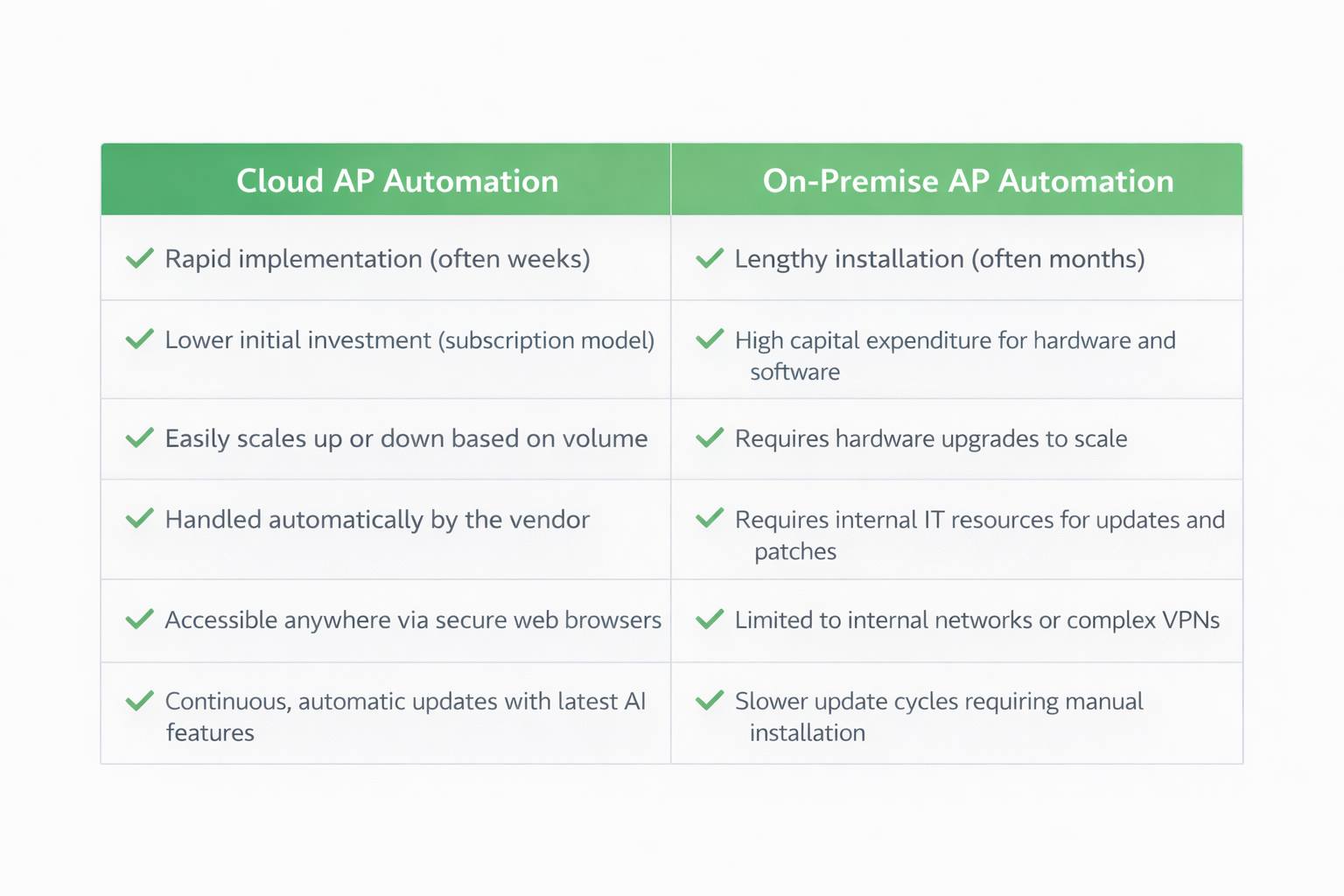
When upgrading your financial infrastructure, choosing between a cloud-based solution and an on-premise installation is a critical decision. Cloud AP automation has become the industry standard for its agility, but evaluating both options helps clarify the best path for your enterprise.
What to Look for in Vendors in 2026
Evaluating vendors requires a nuanced approach, informed by real-world benchmarks and current performance data. Findings from our AP Automation Survey—spanning 34 large enterprises in India—showcase that top-performing organizations achieve over 90% OCR accuracy and auto-post more than 70% of their invoices. High performers also maintain exception rates below 10% and process approval cycles in three days or less, with some teams managing over 100,000 invoices annually while operating lean AP teams. These data points highlight the maturity gap and illuminate what differentiates innovative enterprises from the rest.
In a business landscape moving rapidly toward hyperautomation, your chosen AP automation platform must be resilient, intelligent, and equipped to meet evolving performance expectations. Consider these real-world trends and variances as key criteria in your vendor evaluation process.
Keep these actionable insights in mind when evaluating vendors:
- Assess Native AI Capabilities: Do not settle for basic OCR. Look for vendors offering generative AI and machine learning models that continuously improve extraction accuracy and automatically detect fraudulent invoices.
- Demand Deep ERP Integration: Your automation tool should act as a natural extension of your ERP. Prioritize vendors offering bi-directional, real-time syncing rather than batch uploads.
- Focus on the Supplier Experience: The best systems include self-service supplier portals. This allows your vendors to submit invoices, check payment statuses, and communicate directly within the platform, drastically reducing the volume of inquiry emails.
- Examine Advanced Analytics: Automation generates massive amounts of operational data. Evaluate the vendor's dashboard capabilities. You need real-time visibility into cash flow, bottleneck identification, and working capital metrics to drive strategic decisions.
Conclusion
Accounts payable invoice automation is no longer just a back-office efficiency tool; it is a strategic necessity for modern enterprises. The latest survey data shows that top-performing organizations report over 90% OCR accuracy, auto-posting rates exceeding 70%, and approval cycles of three days or less. By eliminating manual data entry, enforcing compliance, and providing real-time financial visibility, automation empowers your finance team to operate as true business partners—streamlining operations, reducing risk, and elevating AP performance in line with emerging benchmarks.
Take the time to map out your current AP workflows, identify your most significant bottlenecks, and begin evaluating cloud-based solutions that align with your long-term digital transformation goals. Transform your operations today to secure a competitive advantage tomorrow.